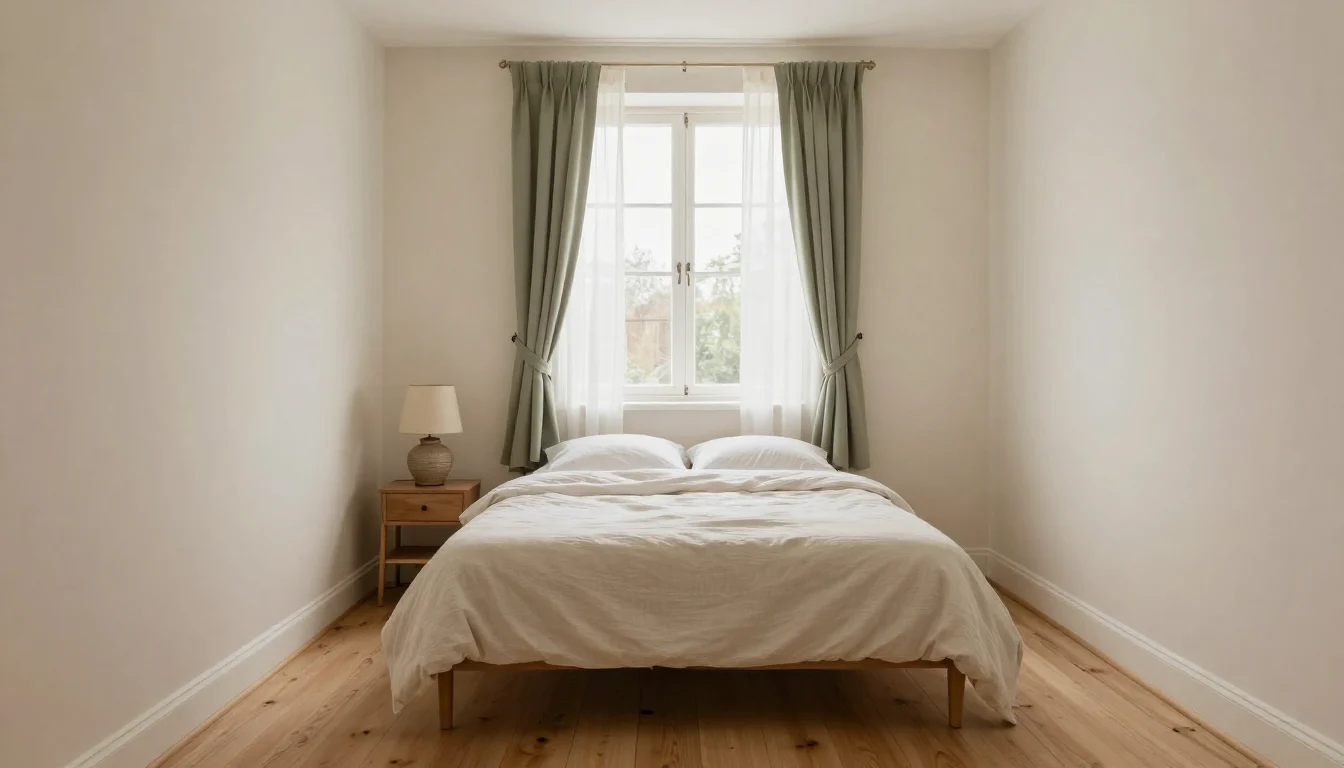
How to Make a Small Bedroom Feel Bigger Without Buying New Furniture
Much of the advice on how to make a small bedroom feel bigger ends with a shopping list: a slimmer bed frame, a storage bed, maybe a Murphy bed. Those can help, but they cost money, and they don’t fix a layout that is working against you.
This guide sticks to what you already have: map the room, take one thing out, try bed positions, borrow light and calm visual clutter. We also flag easy-to-miss safety checks: anchoring tall furniture, keeping the window usable, and avoiding moisture behind pieces on cold walls.
Every step is renter-friendly or comes with a renter alternative. Where something needs drilling or painting, we say so, and suggest you get permission first.
Key takeaways
- Sketch the room first, marking door swings, the window, vents and outlets.
- Removing or swapping one piece is often the easiest place to start.
- Corner and centered beds both work. Choose based on how you sleep and make the bed.
- If you like the idea, try tall pieces on the door wall.
- Keep a clear path from bed to door.
- Anchor tall furniture, moved or not, following the manufacturer’s instructions.
- After rearranging, make sure you can still reach and open the window.
- On cold exterior walls, leave room for airflow behind furniture and under the bed.
In this article
- Start With a Quick Map of Your Room
- Take One Piece Out and Clear the Floor
- Decide Between a Corner and a Centered Bed
- Plan the View From the Doorway
- Keep the Window Easy to Reach and Open
- Use Wall Height, but Anchor Tall Furniture
- Leave Room for Airflow Under the Bed and Along Cold Walls
- Brighten the Room With Daylight, Lamps and Mirrors
- Cut Visual Clutter With What You Already Own
Start With a Quick Map of Your Room
Before you lift anything, sketch the room on paper with rough measurements of each wall and your main pieces. It saves you from dragging a dresser across the room only to find the closet door no longer opens.
Mark everything that swings, opens or needs access, because these points decide where furniture can go more than style does.
Then try layouts on paper first. Before moving anything heavy, use the floor-marking test in the tip below.
Try this: Floor-marking test: outline a piece’s footprint with masking tape or newspaper, then walk around it to check door swings and routes before lifting anything heavy.
Safety note: Moving heavy pieces? Empty the drawers first and get a second person to help.
- Bedroom door: how far it swings into the room and whether anything stops it.
- Closet or wardrobe doors: plus drawers that need room to pull out.
- The window: where it is and how it opens.
- Radiators, heaters and vents.
- Outlets and switches: a bedside lamp needs power nearby, and a switch hidden behind a wardrobe is a daily annoyance.
- Exterior walls: these tend to be colder, which matters for moisture.
Take One Piece Out and Clear the Floor
The fastest way to gain floor space costs nothing: remove something. Small bedrooms often collect furniture that drifted in from other rooms or was kept from a bigger home.
Look for pieces that are doing one small job. A chair that mostly holds clothes, a second nightstand on the side nobody sleeps on, or a freestanding hamper that could live inside the closet are common candidates.
Moving a piece to another room still counts as not buying. A tall bookcase might work better in a hallway, and a compact side table from the living room might replace a bulky nightstand. Think of your whole home as the inventory.
Try this: Not sure about a piece? Move it out for a week. If you don’t miss it, it has earned a permanent new home in another room.
- Clear anything off the floor that doesn’t have a proper home, such as bags, boxes and laundry piles.
- Look inside the closet before the room: the top shelf (for light, seasonal items) and the floor beneath hanging clothes can often absorb things now sitting on the bedroom floor.
- Rethink doors: if you already own an over-door hook rack, it adds storage on the back of a door with no drilling. Taking a closet or cabinet door off can free up swing space, but renters should check their lease first. Doors can be heavy and awkward to lift off their hinges, so get a second person to help, and keep every hinge and screw in a labeled bag.
- If you swap in a piece from another room, confirm that it fits around the door swings marked on your sketch.
- Check that removing a piece doesn’t leave you without a safe place for a lamp or water glass near the bed.
Decide Between a Corner and a Centered Bed
The bed is the biggest object in the room, so its position shapes everything else. Design guides disagree here. Some push the bed into a corner to free up floor, while Real Homes suggests centering it on the main wall with access on both sides. Both can be right, depending on how you live.
Use your sketch to try both, then think about the trade-offs below. If two people share the bed, the centered layout often wins simply because neither sleeper has to climb over the other.
Whichever you choose, keep the window reachable, and leave room for airflow if the bed must go on an exterior wall.
Try this: Only one sleeper? The climb-over downside of a corner bed largely disappears, so a corner layout is often worth trying.
- Corner placement: frees up the most open floor, but making the bed is harder, one sleeper may have to climb over, and the wall side gets little airflow.
- Centered placement: easier to get in and out, more balanced to look at, and simpler to make the bed, but it takes up more floor on both sides.
- Quick test: use the floor-marking test from your room map on both bed positions.
- Special case, kids’ rooms: pair any layout with anchored storage.
- Special case, long, narrow or awkward rooms: try placing the bed across the short end so the rest of the room becomes one straight walkway, and look for alcoves or low-ceilinged spots where a bed or low piece fits without needing standing height.
- Special case, a radiator under the only window: don’t push the bed or other furniture against it. Keep the clearance the heater manufacturer recommends, even if that means this wall holds only a low piece or nothing at all.
Before Corner
1 Nightstand
- Open floor beside the bed
- Wall side reached by climbing over
After Centered
1 Nightstand
- Access from both sides
- Less open floor
- Suits two sleepers
Plan the View From the Doorway
The first glance into a room shapes how big it feels. One common design idea, offered as inspiration rather than a rule, is to place tall or bulky pieces on the same wall as the door so the room reads as more open, because you don’t see them head-on as you walk in.
Test it yourself. Stand in the doorway and look in, then imagine the wardrobe or dresser on the wall you’re facing versus beside you. Keeping the far wall lighter may help the room feel deeper, so see whether that works in your space.
Keep a clear path from the bed to the door, too. It matters at night, and it matters in an emergency.
- If outlets, the closet or door swings force tall pieces onto the far wall: group them together rather than spreading them along the wall, and keep their tops clear.
- If you like the light-color idea, put the palest tall piece you own on that far wall and save darker pieces for the door wall.
- After each move, stand in the doorway again and walk the route from bed to door to confirm nothing now sticks into it.
1 Nightstand2 Plant
- Tall pieces beside the door
- Far wall kept light
- Clear route bed to door
Keep the Window Easy to Reach and Open
Rearranging is when a window most easily gets blocked, especially in a small room where it’s tempting to push a bed or dresser beneath it.
In many US jurisdictions, building codes based on the International Residential Code generally require an emergency escape opening, usually a window, in every room used for sleeping, and escape windows are meant to open from inside without keys or tools. Requirements vary by building type and location, so check with your building manager or local fire authority.
In any home, run this quick check after rearranging:
- Reach the latch: make sure you can get to the window’s latch easily.
- Open it fully: confirm the window opens all the way. If a dresser or bed blocks it, move that piece.
- Check coverings and fittings: make sure blinds, curtains, rods or a window restrictor don’t stop it opening. If a restrictor or lock is fitted, learn how to release it following the manufacturer’s instructions.
- Renters: if the window won’t open, sticks or has a broken latch, report it to your landlord or building manager.
Use Wall Height, but Anchor Tall Furniture
Using wall height is a classic small-room move: a tall dresser in place of a low one, or a few light bins on top of an anchored wardrobe. But moving storage upward raises its center of gravity and adds to tip-over risk. Any tall piece, moved or not, should be anchored.
According to the US Consumer Product Safety Commission, clothing storage units alone were involved in an estimated 84,100 emergency-room-treated tip-over injuries from 2006 to 2021, and CPSC staff knew of 234 deaths from these units between January 2000 and April 2022, 199 of them children. A 2011 CPSC release noted that the most common scenarios involve young children climbing on, falling against or pulling up on furniture.
In the US, a mandatory dresser stability standard took effect on September 1, 2023, according to the CPSC. According to the National Council on Aging, it covers only clothing storage furniture and isn’t designed to protect older children or adults. It’s also sensible to assume that a dresser made before the standard took effect may not have been built to meet it. Outside the US, rules differ.
The simplest takeaway for every reader: use the anchoring kit and follow the instructions that came with your furniture. The CPSC recommends anti-tip devices on TVs, dressers, bookcases and other furniture.
Safety note: Can’t anchor a piece yet? Follow the furniture maker’s instructions on loading drawers, don’t stack anything on top, and keep children from climbing it. This doesn’t replace anchoring where children live or visit.
- Anchor into something solid. NCOA advises fixing anchors into a wood stud, using screws long enough to pass through the drywall and into the stud. If your walls are masonry, plaster or another type, use the hardware and wall-type guidance in your kit’s instructions.
- Never stack heavy items on top of tall, unanchored furniture. Keep only light things up high.
- Renters: anchoring is a safety step, not a cosmetic one to skip. Talk to your landlord about it, and check your lease for rules on wall fixings.
- Height without drilling: rather than adding tall freestanding pieces you can’t anchor, make more use of closet shelves and over-door storage.
Leave Room for Airflow Under the Bed and Along Cold Walls
Sliding boxes under the bed is the go-to tip for clearing floor space, and on many beds it works well. But there’s a trade-off worth knowing.
When furniture sits tight against a cold exterior wall, air can barely circulate behind it, which can let moisture linger. myHOMEBOOK, drawing on guidance from Germany’s Verbraucherzentrale NRW consumer agency, recommends leaving space between furniture and exterior walls to help prevent mold. For beds on exterior walls, it advises against filling the space under the bed with boxes or drawers, because they block airflow.
Recommended gap sizes vary, so we won’t give you a single number. The practical principle is consistent: on cold walls, leave space for air to move, and check behind pieces now and then.
If you rent: Found musty smells, dark spots or mold behind furniture? If you rent, report it to your landlord, and follow your local health or housing authority’s guidance on cleaning it safely.
- Use under-bed storage mainly on beds against interior walls.
- If your bed must sit on an exterior wall, keep the space underneath lighter, leave gaps between containers, and choose open or ventilated bins if you have them.
- Pull large closed pieces like wardrobes slightly away from exterior walls rather than pushing them flush. If you want a small gap behind an anchored piece, check whether your anti-tip hardware allows it and follow the kit’s instructions on strap tension.
- Now and then, look behind furniture on exterior walls for musty smells, dark spots or dampness.
Brighten the Room With Daylight, Lamps and Mirrors
Light changes how big a room feels, and you can improve it without buying anything. Start with the window: clean the inside of the glass, and the outside only if you can reach it from the ground. Don’t lean out of upper-floor windows to reach the glass. Tie curtains back fully so the frame isn’t half-covered during the day.
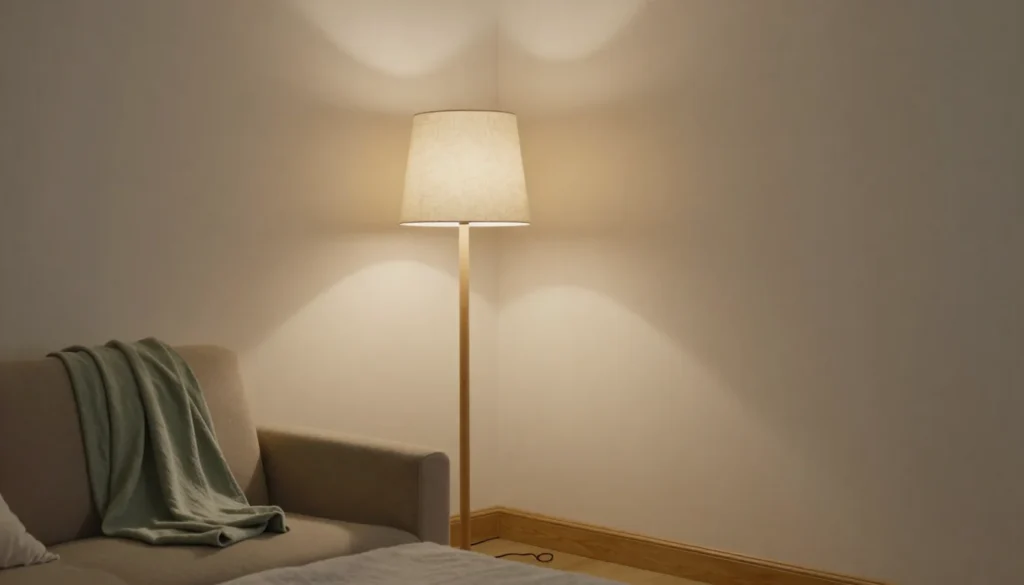
Then look at artificial light. A single overhead fixture tends to leave corners dim. Bringing in a lamp or two from other rooms and placing them in darker corners can make the edges of the room feel farther away. Check each lamp’s label for its maximum bulb wattage, and follow the manufacturer’s instructions for cords and power strips.
Mirrors are the other tool. Design guides don’t agree on one spot: Homes & Gardens, for example, suggests placing one beside a window, while other guides favor different positions. Rather than picking a rule, test it.
- The handheld mirror test: walk a small mirror around the room at different times of day and notice where it catches daylight or a pleasant view rather than a cluttered corner.
- Secure it safely: once you’ve chosen a spot, hang or secure the mirror according to its maker’s instructions. Tall leaning mirrors can tip or be pulled down, so don’t leave them freestanding in a busy path or where children play.
- If you’re using adhesive hooks or strips, check the manufacturer’s stated weight limit and surface guidance on the packaging before trusting them with a mirror or frame.
- Renters who can’t hang a mirror: anchoring furniture is a separate safety fixing that needs its own landlord approval. If you have that approval for a low dresser, you could lean a smaller mirror on top of it, if the mirror maker’s instructions allow it. Set it well back from the edge, and skip this where young children live or visit.
Cut Visual Clutter With What You Already Own
A room full of small objects and competing patterns can feel cramped even when the floor is clear. Calming the look is mostly editing.
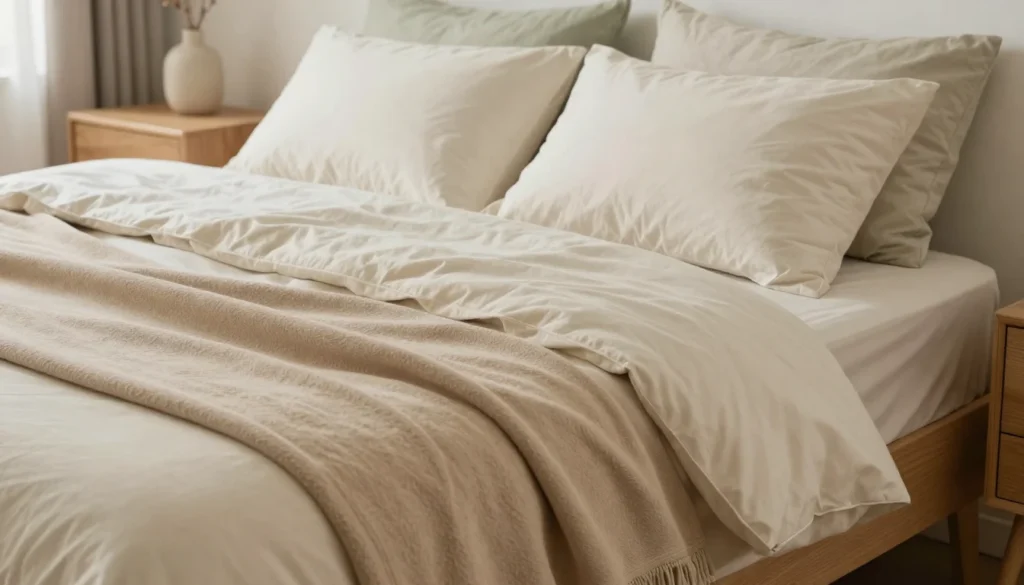
Color is where advice gets loud. Many design sources say light colors make a room look bigger; that’s a popular design idea rather than a proven rule, so treat it as inspiration. If you like the idea, you can try it with what you own: a light duvet, fewer contrasting pillows, or swapping a dark throw for a pale one from another room.
Optional extra (this one costs money): Livingetc suggests painting trim, doors and walls one color for a seamless look, but renters should get written permission from their landlord before picking up a brush.
- Clear surfaces: leave nightstands and dresser tops with just a few useful items.
- Simplify bedding: one or two colors often look calmer than several patterns.
- Move rugs around: try tucking a rug partly under the bed, or move a too-small rug to another room and see if the floor looks better bare.
- Edit wall art: fewer, larger pieces or a single grouping can look tidier than many scattered frames.
Frequently asked questions
Is it better to put my bed in a corner or in the middle of the wall?
Neither is always better. A corner frees the most floor but makes bed-making harder and may mean one sleeper climbs over the other. A centered bed is easier to use but takes more floor. Mark both on the floor and walk your routes before deciding.
Do I really need to anchor a dresser if I rent?
Anchoring is a safety measure, especially if children live in or visit the home, since tip-overs often happen when young children climb on or pull on furniture. Use the kit and instructions that came with the piece, and talk to your landlord about fixing it to the wall.
Can I use under-bed storage if my bed is against an outside wall?
Be cautious. Tightly packed storage under a bed on a cold exterior wall can block airflow and may let moisture build up. Keep the space lighter, leave gaps between containers, and check for dampness regularly.
Where should I hang a mirror to make the room look bigger?
Design guides don’t agree on one spot. Carry a handheld mirror around the room at different times of day to see where it reflects light or a calm view, then hang or secure it following the mirror maker’s instructions.
Do light colors actually make a bedroom look bigger?
It’s a widely shared design idea rather than a proven rule, so treat it as inspiration. Try it for free with lighter bedding, throws or rugs you already own. Renters who want to paint should get written permission from their landlord first.
You don’t need new furniture to make a small bedroom feel bigger. Map the room, take one piece out, try the bed in a couple of positions, and let the view from the doorway breathe. Borrow lamps from elsewhere in your home, test where a mirror works, and edit what’s on surfaces and walls.
As you rearrange, keep three safety checks in mind: anchor tall pieces according to their instructions, keep the window reachable and openable, and leave airflow where furniture meets cold walls. Those steps help keep your home safer, and they make the extra space you’ve found one you can actually enjoy.
Sources
- www.anchorit.gov — CPSC clothing storage unit tip-over injury and death figures; mandatory standard effective September 1, 2023
- www.federalregister.gov — Text of the mandatory US safety standard for clothing storage units
- www.ncoa.org — Limits of the US standard; anchoring into a wood stud with screws long enough to pass through the drywall into the stud
- www.cpsc.gov — CPSC advice to install anti-tip devices on TVs, dressers, bookcases and other furniture
- www.cpsc.gov — 2011 CPSC release noting common tip-over scenarios involve young children climbing on, falling against or pulling up on furniture
- ghtmi.gov — IRC-based requirement, as adopted in many US jurisdictions, for an emergency escape opening in every room used for sleeping
- www.familyhandyman.com — Escape windows must open from inside without keys or tools
- www.myhomebook-magazine.com — Advice, drawing on Verbraucherzentrale NRW guidance, to leave space between furniture and exterior walls to help prevent mold, and not to fill under-bed space on beds against exterior walls
- www.realhomes.com — Suggestion to center the bed on the main wall with access on both sides
- www.homesandgardens.com — Suggestion to place a mirror beside a window
- www.livingetc.com — Suggestion to paint trim, doors and walls one color
Illustrations in this article are concept renderings, not photographs of real homes or projects. This article was checked against the sources listed above and our editorial policy.